NEED TO KNOW: The most important facts, stats and trivia ahead of the 2026 Japanese Grand Prix
As F1 heads to the Suzuka Circuit for the Japanese Grand Prix, Need to Know is your all-in-one guide with statistics, driving pointers, strategy tips and more.
.webp)
The 2026 Formula 1 season continues this weekend with the Japanese Grand Prix, marking Round 3 of the championship.
Free Practice 1 and 2 will take place on Friday, March 27, followed by Free Practice 3 and Qualifying on Saturday, March 28 and the main event itself, the 53-lap Japanese Grand Prix, on Sunday, March 29.
Vital Statistics
- First Grand Prix – 1987
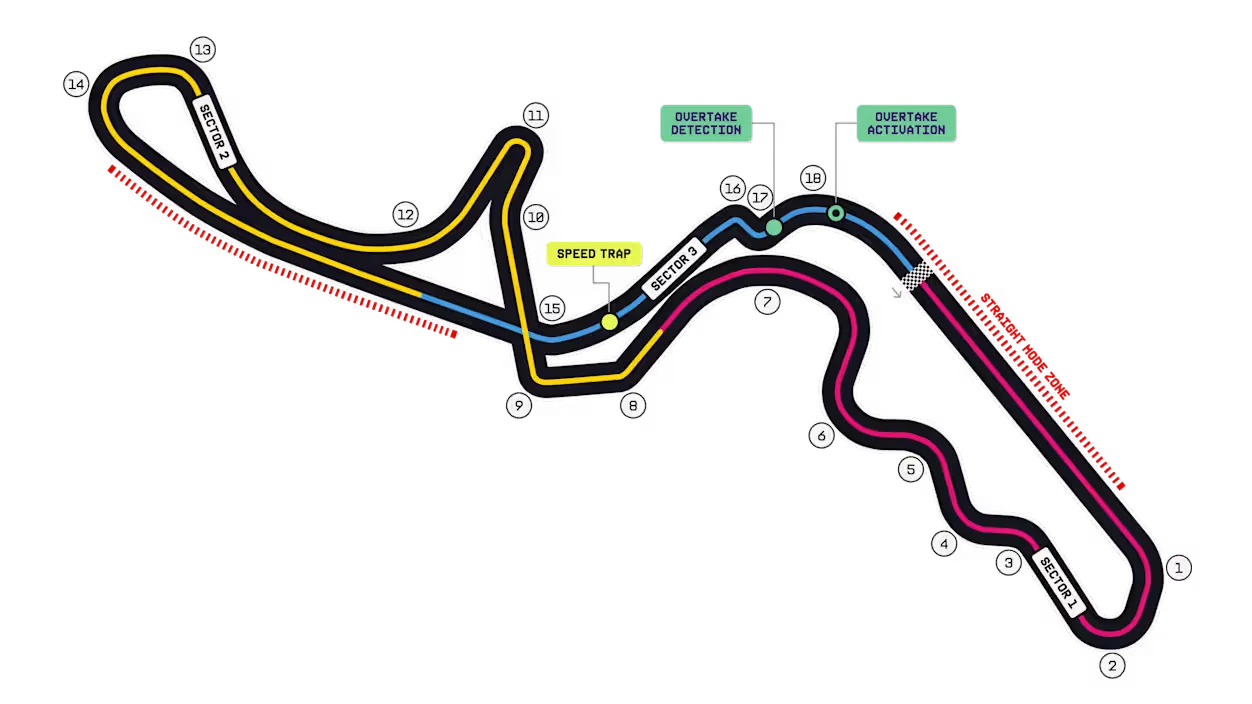
- Track Length – 5.807km
- Lap record – 1m 30.965s, Kimi Antonelli, Mercedes, 2025
- Most pole positions – Michael Schumacher (8)
- Most wins – Michael Schumacher (6)
- Trivia – Suzuka is the only figure-of-eight track on the F1 calendar
- Pole run to Turn 1 braking point – 342 metres
- Overtakes completed in 2025 – 28
- Safety Car probability – 50%*
- Virtual Safety Car probability – 33%*
- Pit stop time loss – 23.75 seconds (including 2.5s stationary)
*From the previous six races in Japan
The driver's verdict
Jolyon Palmer, former Renault F1 driver: Suzuka is another drivers’ favourite and another one that’s a lot about flow. Across the first sector in particular there’s no real reference points after you ping it into Turn 1.
It’s all based on feel from Turns 2 to 7, just gauging the grip and balancing the car right on the edge through all the ‘S’ bends which culminate at Turn 7.
After that it’s the Degners, which are mistake inducing. If you carry too much speed into Degner 1 you will struggle to stop for Degner 2. The hairpin that follows is not so bad; you’re braking a bit for the right hander, so you’ve got to be careful on peak brake pressure.
The second part of Spoon I found tricky, as you’re desperate to get on the throttle, and if you go too early it can draw you out onto the kerbing or beyond, and you have to back out and lose time.
130R is easy peasy, and then the chicane is a bit like Spa, maybe a little less dramatic, but you have to round out the lap with a tight sequence, lump a bit of kerb, and it’s all about the braking.
Last five Japanese GP polesitters
- 2025 – Max Verstappen (Red Bull)
- 2024 – Max Verstappen (Red Bull)
- 2023 – Max Verstappen (Red Bull)
- 2022 – Max Verstappen (Red Bull)
- 2019 – Sebastian Vettel (Ferrari)
Last five Japanese GP winners
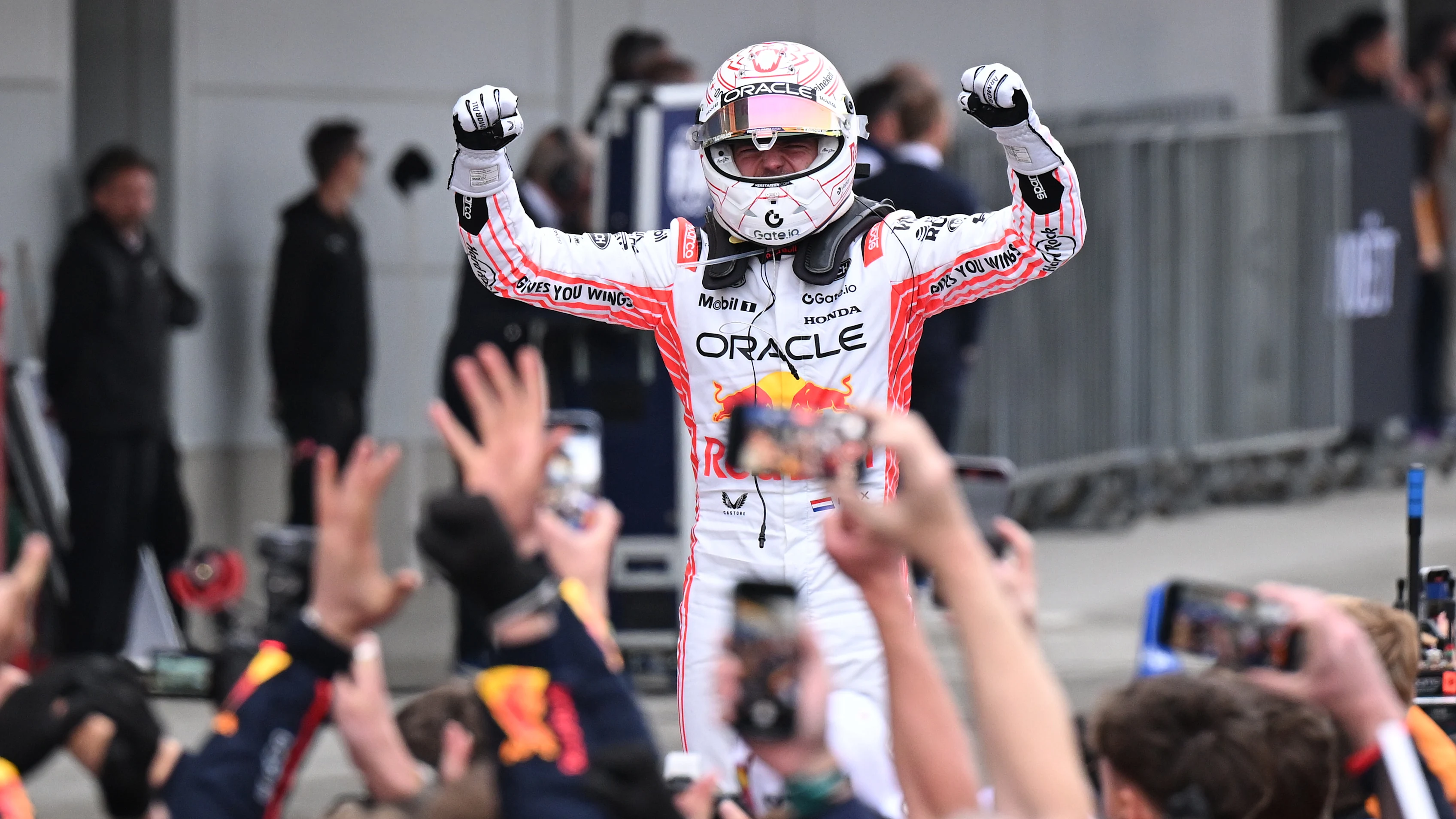
- 2025 – Max Verstappen (Red Bull)
- 2024 – Max Verstappen (Red Bull)
- 2023 – Max Verstappen (Red Bull)
- 2022 – Max Verstappen (Red Bull)
- 2019 – Valtteri Bottas (Mercedes)
Tyre and strategy insight
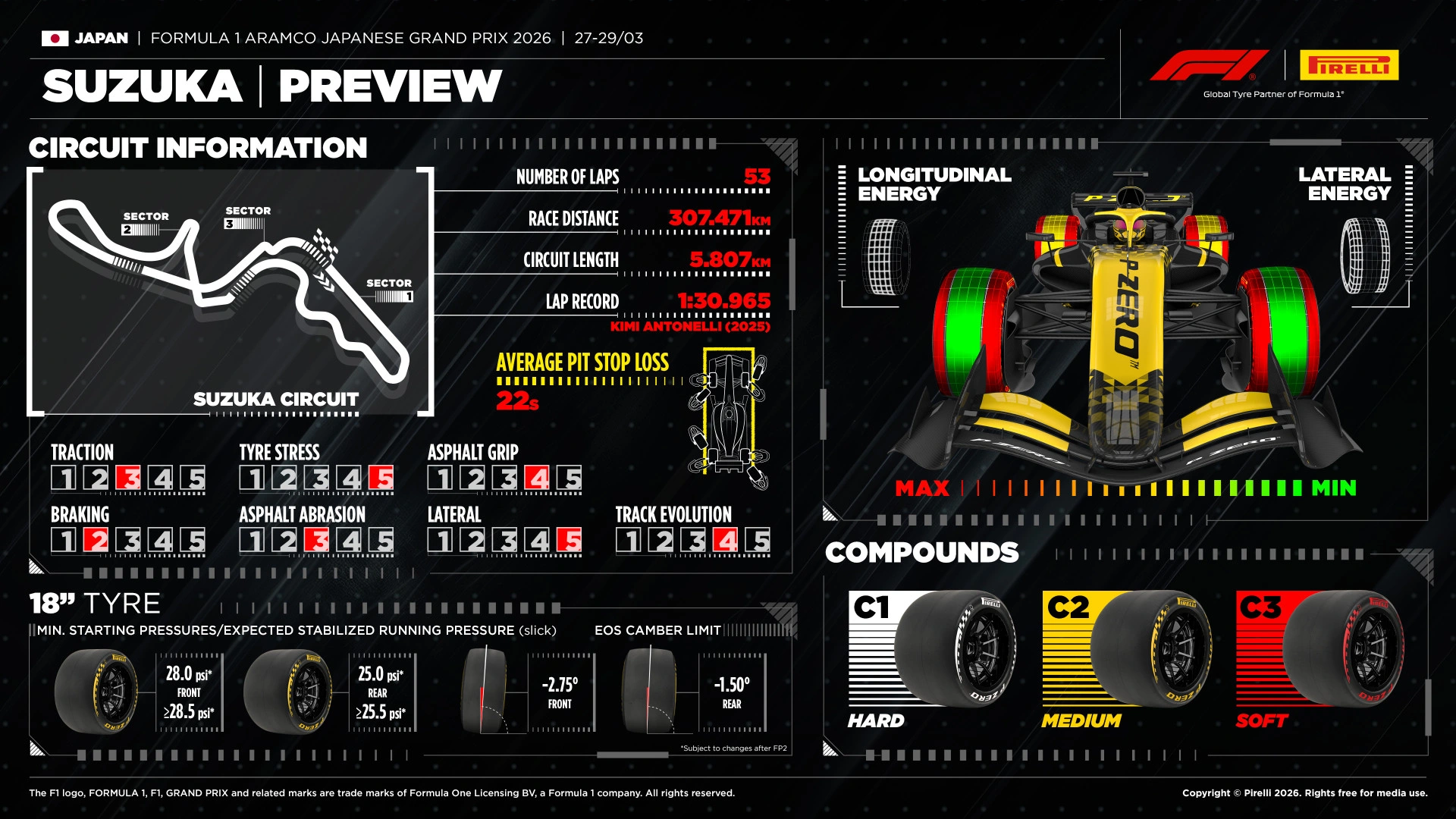
“The forces and loads generated by the continuous changes of direction, combined with highspeed sections, make the 5.807 kilometre Japanese track one of the toughest for tyres,” reads Pirelli’s weekend preview.
“The compounds selected are therefore the three hardest in the range: C1 for the hard, C2 for the mediums and C3 for the soft. This means the hardest option, C1, will make its debut in Suzuka, having not been chosen for the first two race weekends of the season.
“The Honda-owned circuit was resurfaced ahead of the 2025 event, from the exit of the first chicane to the end of the first sector. This year the work continued with the substantial completion of the remaining two sectors up to Turn 17. The asphalt is therefore expected to be smooth and still dirty, offering relatively low grip.
“In these conditions it is normal to expect some graining, particularly with the softest compound. Last year its appearance, limited to the front axle, progressively diminished after the opening day thanks to the track evolution.
“However, the wider extent of the new asphalt surface, which has similar characteristics to that of the first sector, could require closer monitoring of the phenomenon this year and of its impact on degradation. By Friday we will already have a clearer idea of what the teams can expect over the weekend.
“It will be particularly interesting to observe the behaviour of both the hardest and the softest compounds in the selection. Should the C1 offer good grip levels and the C3 prove as consistent as it did in Shanghai, all three options could play a significant role in shaping the race strategies.
“Temperature will also be a key factor. The Japanese Grand Prix is held one week earlier than last year, when ambient temperatures had already settled around 15°C. If there are no significant increases, thermal degradation will remain contained.
“The possibility of completing the race with a single stop could therefore depend on the actual extent of the graining and its consequent influence on performance. Certainly, the teams will need to pay close attention to Qualifying preparation, when it will be essential to bring the tyres up to the correct temperature.”
Current form
The season-opening double header of races could hardly have gone better for Mercedes, with the team claiming back-to-back 1-2 finishes in Australia and China – but while it was George Russell who led the way at the former, the latter saw Kimi Antonelli score his maiden F1 win.
It will be fascinating to see if Antonelli carries that momentum through to the upcoming weekend in Japan, or if Russell – who leads the Drivers’ Standings by four points from his team mate – will take the upper hand.
While the Silver Arrows have collected the most points so far, the squad have been pushed hard by Ferrari during the opening rounds. A rejuvenated Lewis Hamilton – fresh off the back of his first podium for the Scuderia in Shanghai – could be one to watch, given that the Briton is a five-time winner of the Japanese Grand Prix.
Behind those teams, McLaren and Red Bull will both be keen to bounce back at Suzuka, having each endured challenging weekends last time out; neither McLaren driver was able to start the Chinese Grand Prix, while Max Verstappen retired from the event and Isack Hadjar came home in eighth place.
Elsewhere, Haas have enjoyed a particularly strong start to the campaign – so much so that they currently sit ahead of Red Bull in fourth place of the Teams’ Championship – but Racing Bulls and Alpine have also moved into double figures in points, hinting at a close battle in the midfield.
Audi, meanwhile, will be facing their first weekend following the exit of Team Principal Jonathan Wheatley, whose immediate departure from the squad was confirmed a few days on from the Chinese Grand Prix.
Iconic moment
F1’s visit to Japan in 1989 yielded one of the most dramatic moments the sport has ever seen, with title rivals and McLaren team mates Alain Prost and Ayrton Senna banging wheels as they fought over the lead.
Reigning World Champion Senna entered the weekend knowing he needed to win at Suzuka and the season finale at Adelaide to have any chance of retaining his world title, with Prost leading the way by 16 points.
Starting from pole position, Senna fell behind Prost as the lights went out and spent the early exchanges trailing by several seconds, but the balance of power shifted as the race developed and a tense battle brewed.
Senna eventually got close enough to attempt a move on Prost, hugging the sister McLaren through the high-speed 130R left-hander and lunging down the inside into the chicane, only for the two cars to make contact.
While Prost was out on the spot, Senna managed to continue, pit for a new front wing and regain the lead. However, after crossing the line to take victory, the stewards disqualified him for missing the chicane as he rejoined the track.
Relive the drama, and the fallout from the infamous incident, in the video player below...
Next Up
Related Articles
 McLaren can ‘have the best car this year’ – Norris
 Red Bull ‘nowhere near’ the frontrunners – Verstappen
 Why Japanese car culture makes racing at Suzuka so special
 5 iconic Japanese Grand Prix battles
.webp) UnlockedWhy we could see a very different type of Japanese GP in 2026
UnlockedWhy we could see a very different type of Japanese GP in 2026 Russell wary of threats to Mercedes' dominance ahead of Japan